

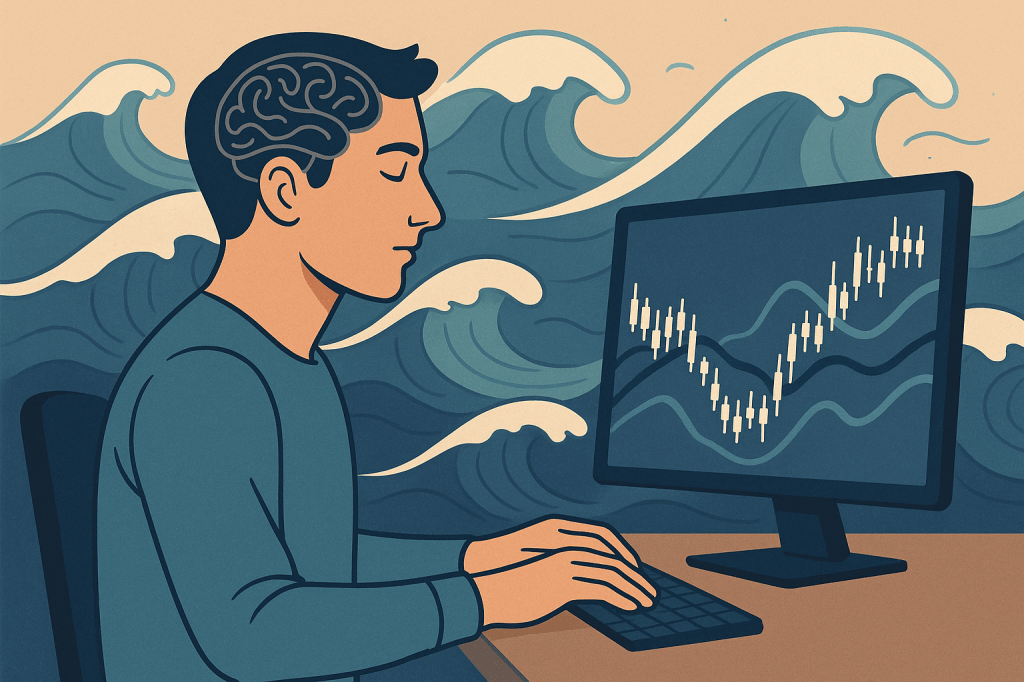
Fear is not a weakness. It’s not a mindset problem. It’s simply a natural human response built into us for survival. When we face something that feels risky, uncomfortable, or uncertain, fear automatically activates. It protects us in daily life — but in trading, the same fear works completely against us.
When fear gets triggered, our physical reaction is to run away from the situation, and mentally, our consciousness narrows. This “narrow mind state” is the real issue. A narrow mind cannot calculate probabilities, cannot think long-term, and cannot follow a trading plan. It only wants relief right now.
Trading is the opposite of that.
To trade well, you must think long-term.
You must rely on math, not emotions.
And you must trust your edge, not your fear.
That is why removing fear is the first big step toward becoming a profitable trader.
Below I’ll explain exactly how fear works in trading, why it harms you, and the step-by-step way I removed fear from my own trading.
1. Fear is Natural — But It Destroys Your Trading Performance
Fear is not your enemy in life. It’s meant to help you survive.
But in trading, survival instincts cause damage because:
- Fear pushes you to run away from the trade
- Fear narrows your awareness
- Fear forces you to act quickly, not intelligently
- Fear makes you obsess over one trade
- Fear makes you see losses as threats to your identity
When your mind becomes narrow, you stop seeing the big picture. Trading success needs calm thinking, long-term vision, and confidence in numbers. Fear kills all three.
2. To Remove Fear, You Must Understand Edge and Probability
Most traders fear the market because they don’t understand what truly controls profit:
your edge and the probabilities behind it.
Your edge is not a magic setup. It is simply a repeatable pattern that works over many trades, not one. Every edge has a win rate and a reward-to-risk ratio. Over time, these two numbers determine whether you make money.
Once you understand that:
- No single trade matters
- Your edge wins over many trades
- Losses are built into the system
- The outcome of one trade means nothing
…your fear naturally weakens.
Fear comes from thinking each trade is “the one that decides everything.” But trading is a numbers game, not a prediction game.
3. You Must Have a Proved or Backtested Edge
You cannot trust something you have not tested.
If you don’t have proof, your brain will panic every time the candle moves against you. But once you backtest or collect data from live trades, you gain trust in your edge.
Real trust doesn’t come from motivation.
Real trust comes from math.
Backtesting shows:
- How often your setup wins
- How big the wins are
- How big the losses are
- How the strategy performs over many trades
This proof becomes the foundation of confidence. And with confidence, fear starts to fade. You don’t remove fear by being brave — you remove it by understanding your edge.
4. You Must Stop Judging Yourself by One Trade
This is the biggest shift.
A single trade is meaningless.
A win doesn’t make you a genius.
A loss doesn’t make you a bad trader.
If your edge needs 100 trades, then the first 1, 5, or 10 trades mean nothing about the long-term result. Once you understand this deeply, fear loses its grip.
Your goal is not to win this trade.
Your goal is to execute this trade according to your rules — because your rules have long-term edge.
Profit comes from series.
Not from isolated trades.
5. Only Two Things Matter: Your Win Rate and Your Risk–Reward
If you want to remove fear, stop thinking about anything except these two numbers:
- Win Rate — how often your setup wins
- Risk–Reward (R:R) — how much you make when you win vs. how much you lose when you’re wrong
These two numbers decide your entire future.
Not hope, not predictions, not candles, not emotions.
When these two numbers are positive over many trades, fear disappears because you understand the math behind your system.
Simple Example of Expectancy
Let’s say:
- Win rate = 40%
- R:R = 1:2
Your expectancy is positive even though you lose more trades than you win.
This understanding alone reduces 60–70% of trading fear.
6. The Practical Steps That Helped Me Remove Fear
Here is the exact process that worked for me:
Step 1: Accept that fear is natural
Don’t fight it. Understand it’s just a survival response, nothing more.
Step 2: Learn how your edge works
Know your setup’s logic, not blindly follow candles.
Step 3: Backtest it
Get data. See how it performs across 50–200 trades.
Step 4: Fix your risk per trade
Only risk an amount you are emotionally comfortable with. If you cannot sleep after entering a trade, your risk is too high.
Step 5: Think in long-term batches
Check your edge after 50 trades, not after one.
Step 6: Focus on execution, not outcome
Replace “Will I win?” with “Did I follow my rules?”
Step 7: Don’t attach your identity to wins and losses
A loss is a business expense, not a personal attack.
A win is just a part of the system, not proof you are special.
These steps remove emotional noise and make trading mechanical and objective.
7. Fear Doesn’t Disappear in a Week — It Fades With Repetition
Removing fear is not an overnight transformation. I didn’t remove fear in two days or one week. It took time because the brain needs proof, not motivation.
Think of it like training your nervous system.
When you trade your edge again and again — without breaking rules — your mind slowly learns:
“Nothing bad happens. I am safe. The edge works.”
This is how fear disappears naturally.
Not instantly.
But slowly and permanently.
8. Final Thoughts — Trading Becomes Easier When You Make It Mathematical
Fear destroys traders not because the market is dangerous, but because they expect certainty where only probability exists.
When you start thinking like a long-term speculator instead of a short-term emotional trader:
- Fear fades
- Patience increases
- Your confidence grows
- You take better trades
- You stop reacting
- You start trusting your system
The moment you stop judging yourself by one trade and start respecting your edge, trading becomes calm.
Fear is natural — but it is not permanent.
Replace emotion with probability.
Replace hope with a proven edge.
Replace survival instinct with trading logic.
That’s how I removed fear from trading.
Anyone can do it with patience, understanding, and discipline.
 Trade Consciously
Leave a comment